
Merida Roman Ruins: A Travel Guide to Spain’s Augusta Emerita
Few places in Europe let you walk through a Roman city as completely as Merida. The capital of Extremadura keeps a theatre, an amphitheatre, a circus, temples, bridges and aqueducts, all within an easy stroll of one another. Autumn is one of the most pleasant times to explore Merida Roman ruins, when the summer heat has faded and the stone glows in the softer light. This guide covers the history, the essential monuments and practical tips for a one- or two-day visit.
Augusta Emerita: a capital at the edge of the empire
Merida began life as Augusta Emerita, founded in 25 BC by the emperor Augustus. It became the capital of Lusitania, one of the provinces of Roman Hispania, and later served as capital of the Diocese of Hispania. Its importance did not end with Rome. The city was a royal seat under the Suebi and the Visigoths, and in the Islamic period it was one of the three border capitals of Al-Andalus.
A UNESCO World Heritage Site
In 1993 the Archaeological Ensemble of Merida was inscribed on the UNESCO World Heritage List. The listing covers 22 separate components spread over about 31 hectares, a reminder that the Roman city is not a single site but a network woven through the modern town. The official UNESCO page for the Archaeological Ensemble of Merida explains why the ensemble is considered an outstanding example of a provincial Roman capital.
The Roman Theatre
The theatre is the image everyone associates with Merida, and it lives up to the photographs. It was inaugurated in 16-15 BC, promoted by Marcus Agrippa, and could hold around 6,000 spectators. Part of the seating was built against the slope of the San Albin hill.
The highlight is the scaenae frons, the monumental stage wall with two tiers of marble columns. Statues found here include figures of Ceres, Pluto and Proserpina, as well as a veiled head of Augustus. Standing in the semicircle of seats, it is easy to imagine an audience waiting for the play to begin.
Still a working stage
The theatre is not only a ruin. It has hosted a classical theatre festival since 1933, giving the ancient stage a long modern tradition. Even outside festival season, the acoustics and the scale of the stage make it clear why it has been brought back to life.
The Amphitheatre and the Circus
Right next to the theatre stands the amphitheatre, inaugurated in 8 AD. It held around 15,000 spectators and was used for gladiator fights and shows with wild animals. You can still see the arena, the central pit and the entrances used by fighters.
A short walk away lies the Roman circus, the venue for chariot races. It measured around 400 metres long and 100 metres wide and could seat about 30,000 people. Much of the seating has gone, but the sheer size of the track is impressive, and the visitor centre helps you picture the races.
Temples, houses and mosaics
The Temple of Diana
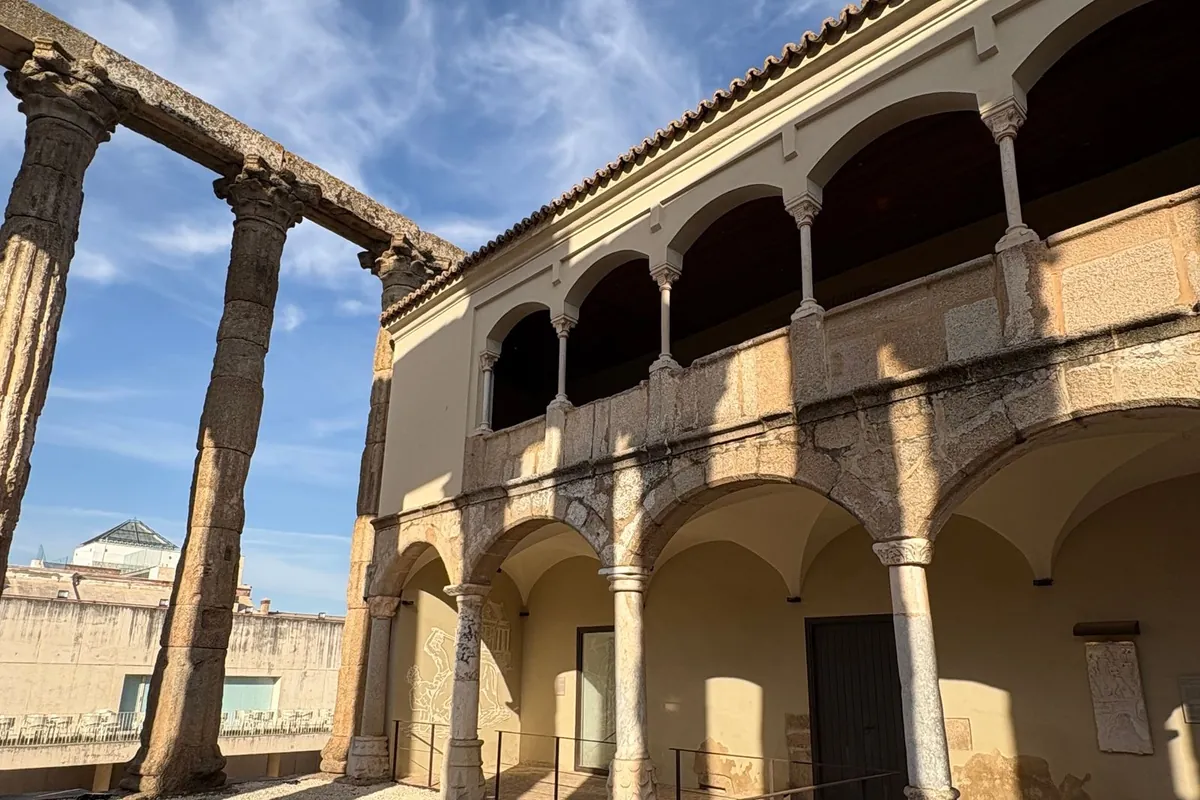
Despite its name, the so-called Temple of Diana was dedicated to the imperial cult of Augustus. Its tall granite columns rise in the middle of the old town, and later builders incorporated part of the structure into a Renaissance palace. The contrast between the Roman colonnade and the later arcades is one of the most photogenic sights in the city.
Casa del Mitreo
This Roman house near the bullring is famous for its cosmogonic mosaic, discovered in the 1960s. The mosaic presents personifications of nature and the cosmos, and it is one of the most complex surviving images of its kind in Hispania.
Water and bridges: Roman engineering
Los Milagros Aqueduct
The Los Milagros aqueduct carried water from the Proserpina reservoir into the city. What survives today is a dramatic line of granite and brick arches crossing the Albarregas valley. It is free to visit, and it is lit at night, so it is worth returning after dinner. Fans of Roman engineering will enjoy comparing it with Spain’s most famous example, described in our autumn travel guide to the Aqueduct of Segovia.
The Roman Bridge
The long Roman bridge over the Guadiana river is one of the great surviving bridges of the Roman world and is still used by pedestrians. Walking across at sunset gives some of the best views of the city.
Beyond the Roman era
Merida’s later history is visible too. The Alcazaba, a fortress built in 835 by Abd al-Rahman II, guards the end of the Roman bridge and includes a cistern reached by steps underground. The Basilica of Santa Eulalia, a thirteenth-century church dedicated to the city’s patron saint, stands over much older remains.
The National Museum of Roman Art
No visit is complete without the Museo Nacional de Arte Romano. Designed by the architect Rafael Moneo and opened in September 1986, its tall brick arches echo Roman construction and create one of the finest museum buildings in Spain. Inside are statues, mosaics, coins and everyday objects from Augusta Emerita.
Opening hours and tickets
The museum opens Tuesday to Saturday from 09:30 to 20:00, and on Sundays and public holidays from 10:00 to 15:00. It is closed on Mondays. General admission is 3 euros and reduced admission 1.50 euros. Entry is free on Saturday afternoons from 14:00 and on Sundays, and also for visitors under 18 and over 65, among others. Check the museum’s website before you go in case of changes.
Planning your visit
How long to stay
One full day is enough to see the theatre, the amphitheatre, the museum and a few of the outdoor sites. Two days allow a slower pace, time for the circus and the Casa del Mitreo, and an evening walk to the illuminated aqueduct.
Tips for an autumn trip
Start at the theatre and amphitheatre as soon as they open, before tour groups arrive. Wear comfortable shoes, as many sites have uneven stone surfaces. Combined tickets for the monuments run by the city’s heritage consortium can save money if you plan to see several sites, so ask at the first ticket office you visit.
Merida also makes a good stop on a wider route through western Spain. It sits on the old Via de la Plata, the Roman road that linked the south and north of the peninsula, so it combines naturally with trips to Caceres or Seville.
Why Merida stays with you
What makes Merida special is not one single monument but the way Roman life still frames the modern city. You can cross a bridge the Romans built, sit in their theatre and then have lunch a few streets away from a temple column. For anyone who loves history, art and architecture, it is one of the most rewarding journeys in Spain.