
Aqueduct of Segovia: An Autumn Guide to Segovia’s Roman Wonder
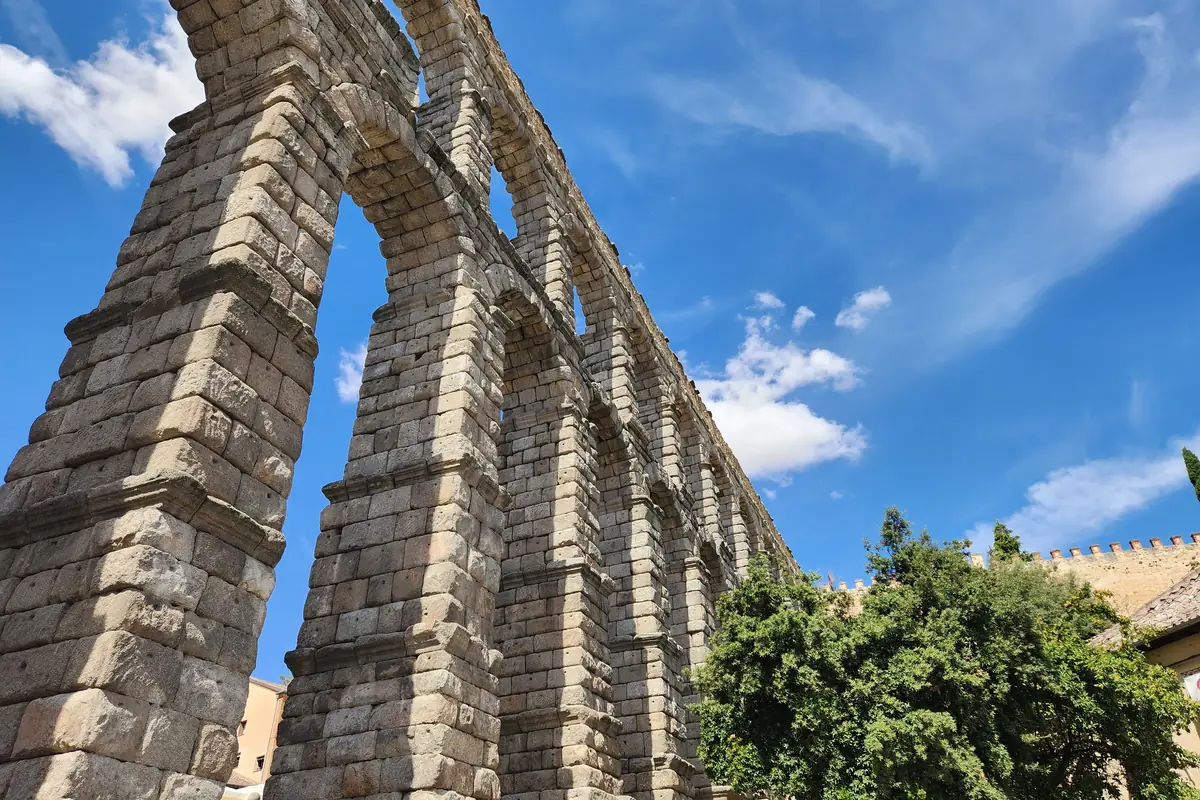
The Aqueduct of Segovia is one of the most impressive Roman monuments anywhere in Europe, and autumn is a lovely time to see it. When the summer crowds thin out and the light turns golden over the Castilian plateau, the granite arches seem to glow against the sky. Add a fairy-tale castle, the last great Gothic cathedral built in Spain and a compact old town full of Romanesque churches, and it is easy to see why Segovia is one of the favourite excursions from Madrid.
A Roman Masterpiece Still Standing
Segovia sits close to the northwestern slopes of the Sierra de Guadarrama, on a rocky ridge between two rivers. The Romans needed a way to bring fresh mountain water up to the settlement on top of that ridge, and the aqueduct was their answer. The system carried water from springs in the mountains about 17 kilometres away to the town’s fountains, baths and houses.
Most visitors see only the most spectacular part: the elevated bridge of arches that crosses the lower town and ends near the Plaza del Azoguejo. It has 167 arches in total, many of them arranged in two levels. At its tallest point the structure reaches 28.5 metres, including nearly six metres of foundation. It is considered one of the best-preserved Roman aqueduct bridges in the world.
Built Without Mortar
The most remarkable detail is the construction itself. The aqueduct is built from large blocks of granite fitted together without any mortar, held in place by careful engineering and their own weight. On top runs a narrow U-shaped channel through which the water flowed. Standing beneath the tallest arches and looking up, it is hard to believe the stones are simply resting on one another.
When Was It Built?
The date has long been debated, partly because the bronze letters of its original inscription are missing. Scholars once placed it in the late first century AD, and research on the holes that held the lost letters pointed to the reign of Emperor Domitian. Archaeological evidence published in 2016, however, suggests a slightly later date, after 112 AD, under Trajan or at the start of Hadrian’s reign. What is certain is the remarkable lifespan: the aqueduct carried water to Segovia until 1973.
Repairs, Niches and the Medieval City
The aqueduct has not survived entirely untouched. A section was destroyed in 1072, and in the late fifteenth century, under the Catholic Monarchs Ferdinand and Isabella, 36 arches were rebuilt with care to respect the original design. The work was led by Pedro Mesa, prior of the nearby monastery of El Parral.
Look closely at the tallest part and you will see two niches, one on each side. According to tradition, one held an image of Hercules, the legendary founder of the city, and now contains an image of the Virgin. The other held a figure of Saint Stephen that has since been lost. The aqueduct is so central to local identity that it appears on Segovia’s coat of arms.
In 1985 UNESCO inscribed the Old Town of Segovia and its Aqueduct on the World Heritage List. The official UNESCO World Heritage page explains why the site was recognised and is a useful read before you go.
What Else to See in Segovia
From the aqueduct, the old town climbs uphill along a lively shopping street towards the Plaza Mayor. Most of the main sights are within walking distance of one another, which makes Segovia ideal for a day on foot.
Segovia Cathedral
The cathedral on the Plaza Mayor is often described as the last Gothic cathedral built in Spain, and it is known as “the Lady of Cathedrals”. Leading architects including Juan Gil de Hontanon and his son Rodrigo Gil de Hontanon worked on it, and it was consecrated in 1768. It is 105 metres long and has 18 chapels, so allow time to wander inside as well as admiring its pinnacles from the square.
The Alcazar of Segovia
At the western tip of the old town, the Alcazar rises on a rocky spur where the rivers Eresma and Clamores meet. The fortress-palace is first documented in 1122, although it may be older, and it was a favourite residence of several kings of Castile, including Alfonso X the Wise and Henry IV.
The Alcazar also played a key role in December 1474. When news of Henry IV’s death reached Segovia, Isabella took refuge within its walls, and on 13 December she was proclaimed Queen of Castile in the city. Much of what you see today was restored after a serious fire in 1862. The building now houses a military archive and the museum of the Royal School of Artillery, and its Throne Room is lined with royal portraits.
Romanesque Churches and the Old Walls
Segovia has an outstanding collection of Romanesque churches built in stone and brick, among them San Esteban, San Millan, San Martin and the Vera Cruz church outside the walls. The medieval wall still encircles much of the historic centre, and the gate of San Andres leads into the old Jewish Quarter, which preserves a number of buildings of Jewish origin.
Why Visit in Autumn?
Segovia sits high on the plateau, and its climate is shaped by that altitude, so summers can be hot and winters cold, with rain and snow more frequent in the nearby mountains. Autumn sits pleasantly in between. Mornings are fresh, afternoons are usually mild, and the poplars along the river valleys below the Alcazar turn yellow, giving wonderful views from the paths around the old town.
The city’s own calendar also has an autumn flavour. San Frutos, the patron saint of Segovia, is celebrated on 25 October, when the Carol of San Frutos is sung in the cathedral and activities often follow in the Plaza Mayor, so the town is often lively at the start of the season.
Practical Tips for Your Visit
- Start early at the Plaza del Azoguejo to see the aqueduct in soft morning light before tour groups arrive.
- Walk up the steps beside the aqueduct for a view along the top of the arches and over the rooftops.
- Wear comfortable shoes: the old town is hilly and many streets are cobbled.
- Check opening hours and ticket prices for the cathedral and the Alcazar on their official websites before you travel, as they change with the season.
- Bring a warm layer. Even on a sunny autumn day, the wind on the walls can be cool.
Pairing Segovia With Other Day Trips
Segovia is one of several historic cities that are easy to reach from Madrid, and many visitors combine it with a second excursion on another day. Toledo, with its cathedral, synagogues and paintings by El Greco, makes a perfect contrast; our guide to El Greco in Toledo explains where to see his masterpieces.
Whichever way you plan it, leave time at the end of the day to return to the aqueduct. As the sun drops and the lights come on beneath the arches, the old Roman stones look as timeless as ever, still standing almost two thousand years after they were set in place.