
Visiting the Dali Theatre-Museum in Figueres: History and Tips
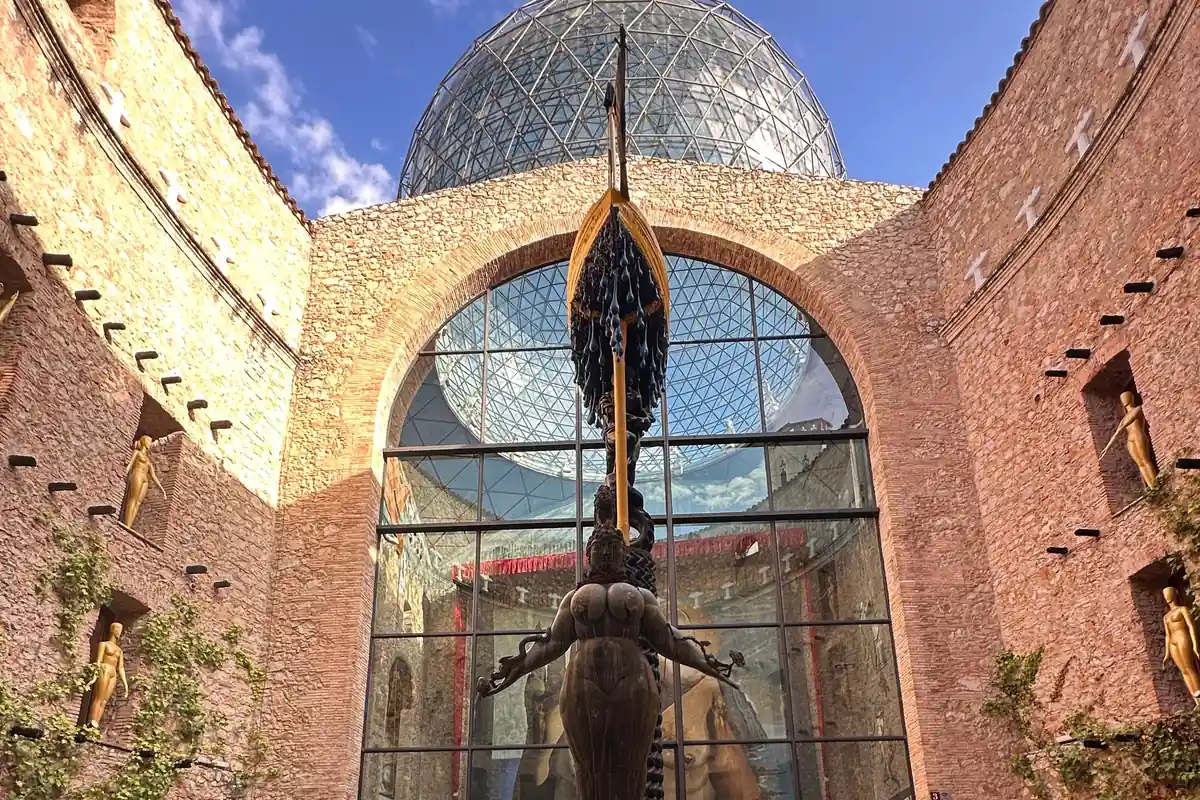
Most museums are buildings that hold works of art. The Dali Theatre-Museum in Figueres is a work of art in its own right. Salvador Dali designed it himself on the ruins of the theatre of his home town, filled it with his paintings, sculptures and installations, and chose to be buried beneath it. The Gala-Salvador Dali Foundation calls it the world’s largest surrealist object, and after a visit it is hard to disagree. This guide covers its history, the highlights you should not miss and practical tips for planning a day trip.
A museum born from a ruined theatre
Salvador Dali was born in Figueres, a market town in the Alt Emporda area of Catalonia, on 11 May 1904. The building that now houses his museum was the town’s old municipal theatre, a place he knew from his youth. As a teenager he took part in an exhibition there, so the site had personal meaning long before it became a museum.
The theatre was badly damaged by fire at the end of the Spanish Civil War and stood as a ruin for years. In the 1960s Dali agreed with the town to turn the shell into a museum devoted to his work. Rather than restoring the old theatre, he decided to transform it, keeping the sense of a stage and an auditorium while turning the whole building into a stage set for his imagination.
Opening in 1974
The Dali Theatre-Museum was inaugurated in 1974. Dali kept working on it for the rest of his life, adding rooms and objects and adapting spaces. In his last years he lived in the Torre Galatea, the tower attached to the museum, and he died in Figueres on 23 January 1989. He was buried in a crypt inside the building, beneath the area of the former stage.
The building: eggs, bread and a glass dome
You will recognise the museum long before you reach the entrance. The red walls of the Torre Galatea are studded with shapes resembling the traditional bread loaves of Catalonia, and the roofline is crowned with giant eggs, recurring symbols in Dali’s work. Gilded figures stand along the top of the walls like an audience looking down at the town.
The most striking feature is the transparent geodesic dome that rises above the old stage. It was designed by the architect Emilio Perez Pinero and has become the symbol of the museum and of Figueres itself.
Highlights inside the museum
The Foundation describes the collection as the most extensive group of Dali’s work anywhere, covering his career from his first artistic experiments to the works of his final years. The museum is a labyrinth of levels and rooms, so it helps to know a few key stops.
The courtyard and the Rainy Taxi
The old theatre stalls became an open courtyard, and at its centre stands one of Dali’s most famous installations, the Rainy Taxi. It is a black vintage car with figures inside, and when it is activated water rains down inside the vehicle. Behind it rises a tall column topped by a boat and a large female figure, framed by the curved walls and windows of the former auditorium.
The Mae West Room
One of the most playful spaces is the room inspired by the actress Mae West. Seen from a particular viewpoint, the furniture and objects in the room come together to form her face: a sofa becomes her lips, the fireplace her nose and framed pictures her eyes. Expect a queue to climb up to the spot where the illusion works best.
The Palace of the Wind
The Palace of the Wind room is dominated by a huge painted ceiling showing Dali and Gala ascending towards the sky, seen from below so that the soles of their feet appear in the foreground.
The stage and the optical illusions
Under the dome, look for the large painting Gala Nude Looking at the Mediterranean Sea, which at a distance turns into a portrait of Abraham Lincoln. Dali loved double images and optical tricks, and the museum is full of them.
Adjoining the main museum is a separate space devoted to the jewels Dali designed, a part of his work many visitors do not expect. Check what your ticket covers when you buy it.
Practical tips for your visit
Opening hours
According to the Gala-Salvador Dali Foundation, from 1 October to 31 December the museum opens Tuesday to Sunday, from 10:30 am to 6:00 pm, with some exceptional Monday openings. In July and August it opens every day with longer hours. Last admission is 45 minutes before closing, and the rooms start to close 15 minutes before closing time. The museum is closed on 1 January and 25 December and closes early on 24 December. Hours change by season, so check the official website before you travel.
Tickets and prices
At the time of writing, general admission starts at 18.50 euros, with a reduced ticket from 15.00 euros for groups such as students over 18, young people aged 9 to 17 and visitors over 65. Children up to the age of 8 enter free. A guided tour option is also offered at a higher price. Buying tickets online in advance is wise, especially in summer, at weekends and during holidays, when queues can be long.
Getting to Figueres
Figueres lies in the province of Girona, not far from the French border, and makes an easy day trip from Barcelona or Girona. The town has rail connections, including high-speed services, and the museum sits in the centre on the square that now bears the names of Gala and Salvador Dali.
How long to stay
Plan at least two hours inside, and more if you like to linger. The layout can feel confusing, so pick up or download the museum map. Arrive early in the day to enjoy the courtyard before the crowds build.
The Dalinian Triangle
The Figueres museum is one point of what is often called the Dalinian Triangle. The other two are the Gala Dali Castle in Pubol, the medieval castle Dali gave to his wife Gala, and the Salvador Dali House-Museum in Portlligat, near Cadaques, where the couple lived and worked for decades. All three are run by the Foundation, and the house in Portlligat in particular needs booking well ahead because visits are limited.
If one trip is not enough Dali for you, our article on the Dali and Freud exhibition at the Thyssen in Madrid explores his fascination with dreams and the unconscious. And for another great Catalan master with his own dedicated museum, read our guide to Joan Miro and the Fundacio Joan Miro in Barcelona.
Is it worth the trip?
Absolutely. Even visitors who are not fans of surrealism tend to leave the Dali Theatre-Museum smiling. It is theatrical, witty, sometimes unsettling and always surprising, which is exactly what Dali intended. Few artists have built such a complete portrait of themselves, and fewer still have chosen to rest at the centre of it.