
Dan Flavin: Some Light at the Guggenheim Bilbao, a Visitor’s Guide
One of the most anticipated shows of the Spanish autumn is about to switch on, quite literally. Dan Flavin: Some Light brings the American artist’s fluorescent works to the Guggenheim Museum Bilbao from mid-November 2026 until 4 April 2027. For anyone curious about Dan Flavin at the Guggenheim Bilbao, this guide explains who he was, why a tube of shop light became a work of art, what the exhibition is expected to include and how to fit it into a visit alongside the museum’s other autumn shows.
Who was Dan Flavin?
Dan Flavin was born in New York in 1933 and died in New York State in 1996. For more than thirty years he worked almost entirely with one material: the ordinary fluorescent light fixture, the same kind found in offices, garages and shop ceilings.
He began making art with these lights in 1963. According to the Guggenheim Bilbao, Flavin described his attitude in a simple phrase: “electric light is just another instrument”. It was a radical break. A fluorescent tube needs no frame, no plinth and no painted surface. It sits on the wall or the floor, and its light spills into the room, changing the colour of the walls, the floor and even the visitors.
A key figure of Minimalism
Flavin is usually grouped with the Minimalist artists who emerged in the United States in the 1960s. They shared an interest in industrial materials, simple geometric forms and arrangements in which no single part is more important than another. Flavin’s version of this approach was unusual because his main subject was not really the object at all. It was the light it produced and the space that light transformed.
He also worked within strict limits. Commercial fluorescent tubes come in a small range of colours and standard lengths, so every work had to be built from the same basic units. Within those rules he developed what the museum calls an architectural vocabulary of “corners”, “monuments”, “barriers” and “corridors”.
Early works and their dedications
One charming feature of Flavin’s art is the way he dedicated many pieces to people he admired. One of his first fluorescent works, the diagonal of May 25, 1963, carries a dedication to the sculptor Constantin Brancusi. From 1964 he began a long series of so-called “monuments” for V. Tatlin, honouring the Russian Constructivist Vladimir Tatlin.
The Guggenheim Bilbao illustrates its exhibition page with a work from 1966 that shows his humour as well as his seriousness: greens crossing greens (to Piet Mondrian who lacked green). The title is a playful nod to the Dutch painter, whose abstract grids famously avoided green. The work is made of green fluorescent light in two sections, one about 6 metres wide and the other about 6.7 metres wide, and it belongs to the Solomon R. Guggenheim Museum in New York as part of the Panza Collection, acquired in 1991.
Why the titles matter
Because the works themselves are so plain, the titles do a lot of quiet work. They point you towards a person, a date or an idea and invite you to think about what light might have to do with friendship, memory or art history.
What to expect from Some Light
The exhibition is part of the museum’s programme of shows drawn from the holdings of the Solomon R. Guggenheim Museum in New York. According to the museum, it will feature works made between the 1960s and the 1980s, with a special focus on Flavin’s early pieces. It is curated by Lauren Hinkson and will occupy galleries 201, 202, 203, 205, 206, 207 and 209 on the second floor. When the museum presented its 2026 programme in January, it described the exhibition as an ambitious presentation sponsored by Iberdrola.
The official exhibition page for Dan Flavin: Some Light lists the dates as 11 November 2026 to 4 April 2027, while the January programme announcement mentioned an opening on 12 November, so it is worth checking the official page before you travel in the first days.
How to look at light art
Flavin’s work rewards a slower kind of looking than many museum visits allow. A few simple habits help:
Walk around each piece rather than standing in front of it. Light changes as you move, and corners or barriers can look completely different from the side.
Look at the walls and floor as much as at the tubes. The coloured glow on the surrounding surfaces is part of the work.
Give your eyes time. After a few minutes in a room of one colour, the next room can look surprisingly different, an effect Flavin was clearly aware of.
Also on view at the Guggenheim this autumn
A visit in the coming weeks can easily combine Flavin with several other exhibitions. On 9 October the museum opened Steve McQueen: 66-76-26 in gallery 105, curated by Lekha Hileman, which runs until 21 February 2027. It is an installation with no image at all. Two recordings of the song Wild is the Wind, by Nina Simone in 1966 and David Bowie in 1976, are stripped of their instruments and placed at opposite ends of a darkened gallery, so that the voices form a duet that never took place.
In the Film and Video gallery, gallery 103, the museum is showing Ever is Over All by Pipilotti Rist, curated by Mikel Onandia, until 17 January 2027. The 1997 two-channel video shows a smiling woman in a light blue dress breaking car windows with a flower, set to a slowed-down soundtrack composed by Rist and Anders Guggisberg.
New in situ installation
From 19 November 2026 to 11 April 2027, the in situ series continues with a new installation by the Korean-Canadian artist Zadie Xa. Throughout the year, visitors can also see Works from the Guggenheim Museum Bilbao Collection, sponsored by the BBK Banking Foundation and completely renovated in November 2025, which presents key moments in art after the Second World War.
Planning your visit
The Guggenheim Museum Bilbao opens Tuesday to Sunday from 10 am to 7 pm. Ticket types and prices change from time to time, so check the museum’s website before booking.
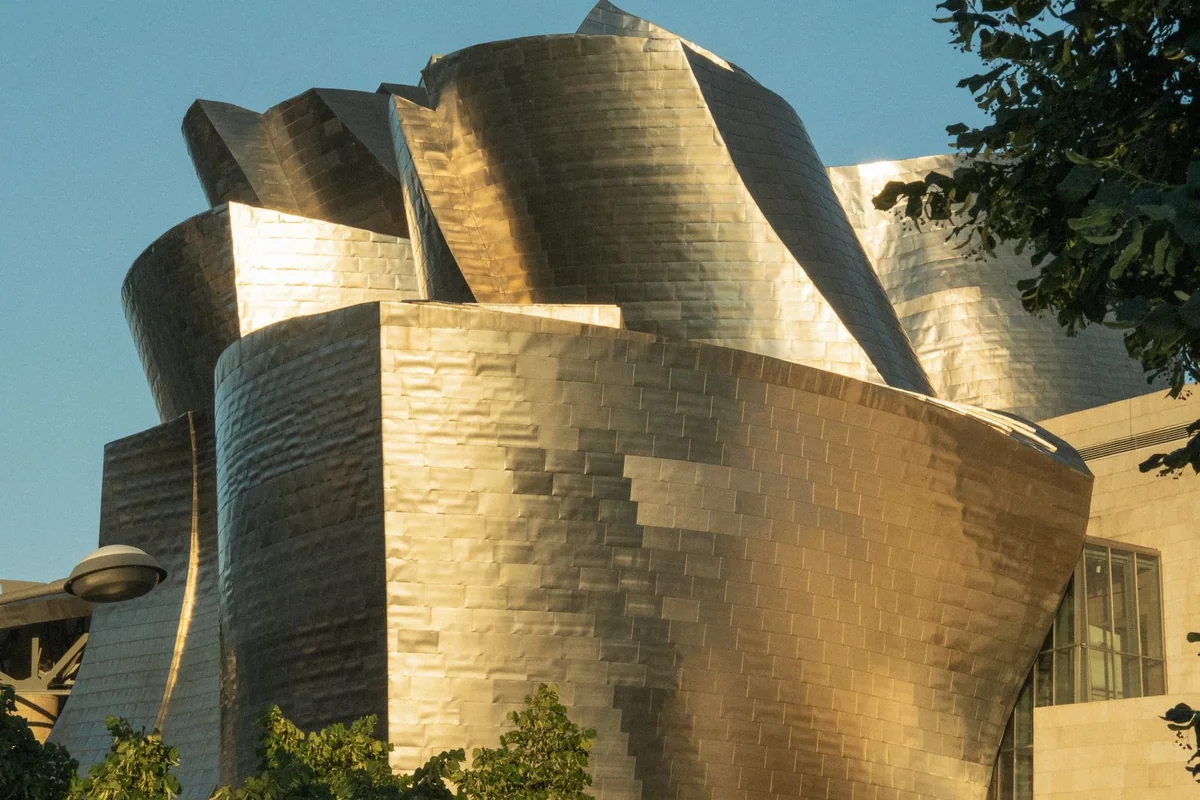
Plan at least an hour for the Flavin galleries, then add time for the McQueen and Rist installations, which are short but immersive. If you are new to the building itself, Frank Gehry’s titanium-clad landmark is an experience in its own right. Our Guggenheim Museum Bilbao visitor guide covers the building and practical tips for your day.
Making a weekend of it
Bilbao works well as a two-day trip. Spend one day at the Guggenheim and along the Nervion river, and the second in the old town. Winter light in the Basque Country is often soft and grey, which makes the glow of Flavin’s tubes feel even more striking when you step inside.
Why this show matters
Flavin’s achievement was to show that something as ordinary as a fluorescent tube could change how we experience a room. Seeing his early works in person matters, because photographs never quite capture the colour of the light. For anyone interested in modern art, Dan Flavin: Some Light looks set to be one of the highlights of the season.